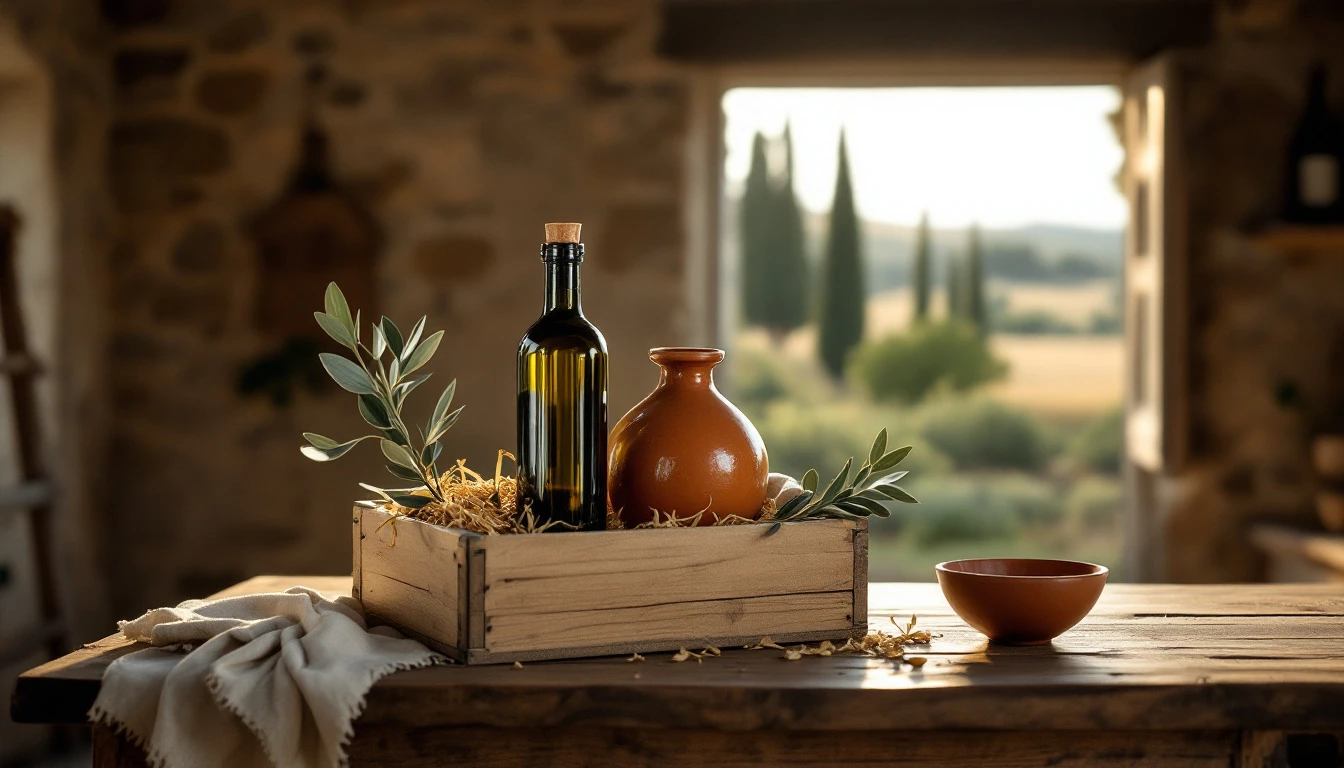
What Single Estate Olive Oil Means: One Grove, One Harvest, One Traceable Origin
Single estate olive oil is extra virgin olive oil made exclusively from olives grown on one named property, harvested in one season, and pressed and bottled under the producer’s control. It is the most verifiable category of olive oil because the answer to “where does this come from?” is a place you can name, locate and visit, not a region, a country or a blend of lots.
The label is only as good as the detail behind it. A genuine single estate oil should tell you the grove or farm, the harvest year, ideally the harvest date, and who pressed it. If any of these is missing, “single estate” is a phrase and not a promise. For a precise reading of the term, see what single estate olive oil means and why it is the most verifiable kind.
This guide covers everything a careful buyer needs: how single estate differs from monocultivar and blends, what makes an oil Tuscan, how harvest timing and cold extraction shape flavour, what polyphenols really tell you, how to store and taste the oil, and how to judge a limited release or a gift. It is written from the Val d’Orcia, where olive growing is measured in centuries and where oil is treated as something to protect.
Single Estate, Monocultivar and Blend: Three Different Questions
These three terms are often confused, yet each answers a different question. Understanding the difference is the quickest way to read a label with confidence.
- Single estate answers where: one property, one set of trees, one microclimate.
- Monocultivar answers which olive: oil from a single variety, such as Frantoio, Leccino or Moraiolo.
- Blend answers how it was composed: several varieties, and sometimes several farms, combined by the producer to reach a consistent profile.
The categories overlap. An oil can be single estate and monocultivar, single estate and blended from several cultivars grown on the same hill, or neither. In Tuscany, the traditional grove is mixed by design: Frantoio brings fruitiness and a green almond note, Leccino softens, Moraiolo adds bitterness and pungency. A blend of these from one estate is entirely classic and entirely traceable.
Our editorial position is clear: provenance outranks variety as a first filter. A monocultivar label tells you about the olive, but not about the farm, the harvest or the handling. A named estate tells you who answers for the oil. Start there, then ask about cultivars, and treat any cultivar claim as valid only if the producer will state it plainly.
Why a Named Grove Matters More Than the Word “Tuscan”
“Tuscan” on a label can mean very different things. It may describe olives grown in Tuscany, oil bottled in Tuscany, a recipe style, or simply an evocative mood. A named grove removes the ambiguity. It gives you a verifiable anchor: a municipality, a hillside, a producer’s name and a harvest year.
Here is a practical test of traceable origin. A trustworthy label lets you answer all of these without guessing:
- Which farm or grove produced the olives?
- In which season, and ideally on which dates, were they harvested?
- Where were they pressed, and by whom?
- Is there a lot, batch or bottle number you can quote back to the producer?
If the answers are “Italy”, “a blend of EU oils” or silence, the oil is anonymous no matter how elegant the packaging. We explore this idea in depth in why a named grove matters more than the word Tuscan. The principle is simple: the smaller and more specific the origin, the harder it is to hide behind it, and the more the producer has staked on the result.
This is also why small producers can be trusted more readily than their size suggests. Accountability scales inversely with distance: one grove, one family, one press, one reputation.
What Makes an Oil Truly Tuscan: Val d’Orcia, Pienza and the Toscano IGP
Tuscan extra virgin olive oil is typically defined by a distinctive sensory profile: intense green fruitiness, pronounced bitterness and a peppery finish that registers in the throat. It reflects cool nights, hillside groves, relatively low yields per tree and a tradition of early harvesting that favours aromatic intensity over volume.
The landscape of the Val d’Orcia
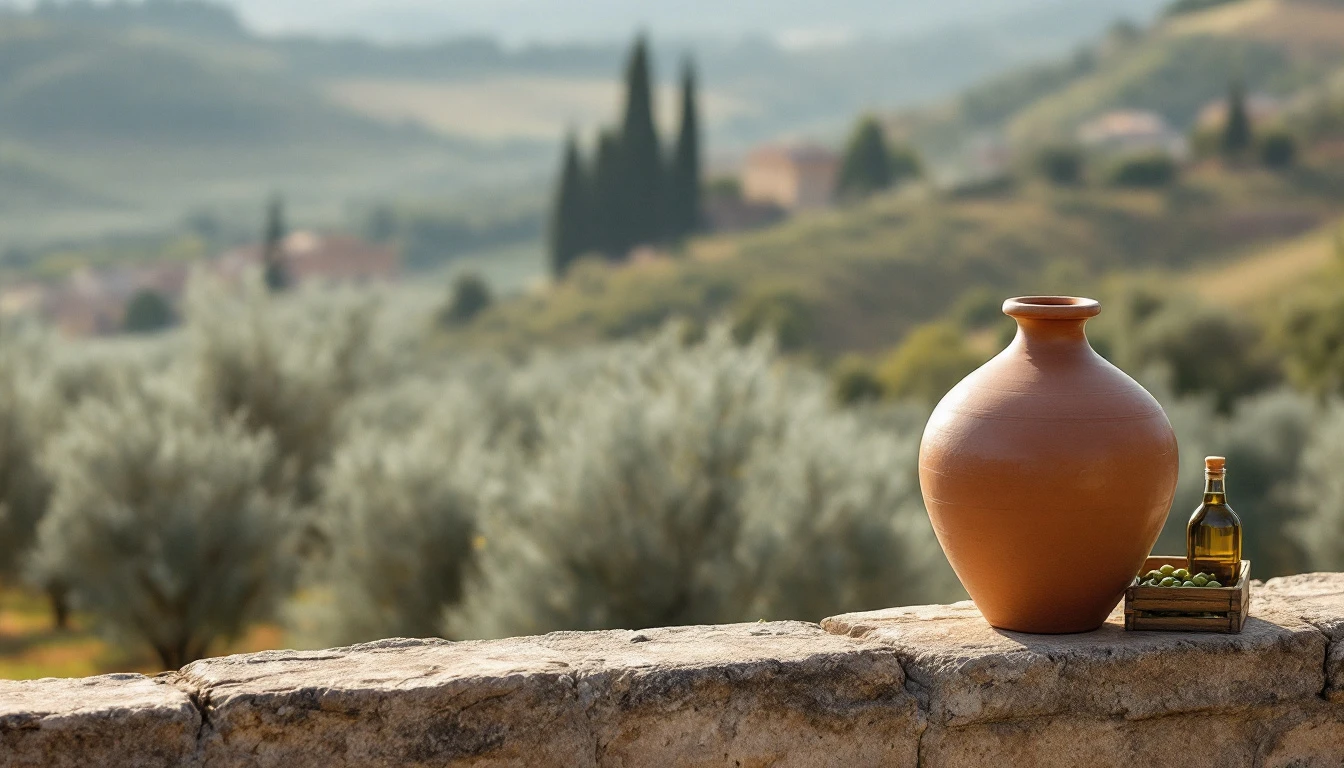
The Val d’Orcia, a UNESCO World Heritage landscape since 2004, surrounds Pienza, Montalcino and San Quirico d’Orcia. Its olive groves sit on clay-rich, well-drained hills between roughly 250 and 500 metres above sea level, where the temperature swing between day and night slows ripening and concentrates aroma. Winter frost is a real risk here, which is why Tuscan growers favour hardy cultivars and prune with care.
The classic Tuscan cultivars
- Frantoio: fruity, herbaceous, with notes of artichoke and almond; the backbone of many Tuscan oils.
- Leccino: milder and rounder; softens the more assertive varieties.
- Moraiolo: low yield, high intensity; contributes bitterness, pungency and a high phenolic profile.
The Toscano IGP
The Toscano IGP (Protected Geographical Indication) is a European designation guaranteeing that olives are grown, pressed and bottled in Tuscany and that the oil meets defined chemical and sensory standards. It is a meaningful guarantee of region, but it does not name a grove. A single estate label and an IGP designation therefore answer different questions and are not substitutes for one another. Always check the actual label for a certification, rather than assuming one from the word “Tuscan”. For a fuller treatment, read our complete guide to Tuscan extra virgin olive oil.
Early Harvest, Cold Extraction and Olio Novello: How Timing Shapes the Oil
In single estate oil, the producer controls the two variables that matter most: when the olives come off the tree and how quickly and gently they are pressed.
Early harvest
In Tuscany, harvest usually runs from mid-October to late November. Early harvest means picking while the fruit is still green or just turning, which gives lower yields (often 10 to 12 kg of olives per litre of oil, against fewer kilos when fully ripe) but a greener, more aromatic, more bitter and more pungent oil with a higher natural phenol content. Later harvests produce softer, sweeter, buttery oils with less stability.
Cold extraction
Cold extraction is a regulated term in the European Union: the olive paste must not exceed 27°C during processing. Keeping it cool preserves volatile aromatic compounds and phenols that heat would strip away. The olives should reach the mill within hours of picking, because fruit left in crates begins to ferment and flaws appear.
Olio novello
Olio novello (“new oil”) is oil released within days or weeks of pressing, often unfiltered, still cloudy and at its most vivid. It is a seasonal celebration, intense and peppery, and is best enjoyed while young. A well-made oil keeps its character beyond the first weeks, but the principle remains: fresh is not a marketing word, it is a date.
Polyphenols in Single Estate Oil: Hydroxytyrosol, Oleocanthal and What a Label Can Honestly Tell You
Polyphenols are a family of natural phenolic compounds found in olives. In oil, they contribute bitterness and pungency, act as natural antioxidants that protect the oil from oxidation, and decline as the oil ages or is exposed to heat and light. Two names recur in discussions of Tuscan oil:
- Hydroxytyrosol and its derivatives: associated with bitterness and with the oil’s stability over time.
- Oleocanthal: the compound responsible for the peppery sting at the back of the throat, which often prompts a cough. That cough is a sensory signal, not a flaw. See why Tuscan extra virgin can make you cough.
We keep this section deliberately sensory and factual. We make no medical claims about olive oil, and you should be wary of anyone who does in a product description. What can be said honestly is that polyphenol content depends on cultivar, ripeness at harvest, extraction and storage, and that it is a marker of an oil’s youth and care.
How to judge a polyphenol-rich oil
- Look for a stated figure. Serious producers publish laboratory results in mg/kg for the specific harvest. Be sceptical of “high polyphenol” with no number. There is no single legal threshold; read how many polyphenols make an olive oil high polyphenol.
- Check the harvest year. Phenols fall over time; a recent harvest is the best predictor.
- Taste it. Real bitterness and a peppery finish are the practical signal that phenols are present.
- Check the container. Clear glass and warm shelves quietly erase what the grove created.
We refuse unproven claims. A number on paper, a harvest date and a sensory test are worth more than any adjective.
Light, Heat and Terracotta: Storing Single Estate Oil and How Long It Lasts
Olive oil has three enemies: light, heat and oxygen. All three accelerate oxidation, which dulls aroma, flattens bitterness and eventually produces a rancid, crayon-like note. Storage is therefore not a detail; it is half the quality equation.
Shelf life, unopened and opened
- Unopened: a well-made extra virgin oil, kept dark and cool, remains good for roughly 18 to 24 months from bottling, but its aromatic peak is earlier. The harvest date is the real clock, as explained in how long Tuscan extra virgin olive oil really lasts.
- After opening: oxygen starts working. For maximum aromatic intensity, we recommend finishing a Tuscan extra virgin within 3 to 4 months of breaking the seal. It does not turn dangerous after that; it simply becomes less expressive.
Ideal conditions
- Temperature: about 14 to 18°C; avoid anything above 25°C and never store near a stove or window.
- Light: total darkness is best; refrigeration is unnecessary and causes cloudiness.
- Air: close the vessel after each use, and prefer small formats that do not leave a large headspace.
Terracotta versus clear glass
Clear glass transmits the full light spectrum, and studies of oils on shelves show measurable quality loss within weeks. Dark glass is a decent compromise. An opaque terracotta vessel blocks light completely, and its thick walls buffer temperature swings. This is the oldest solution in the Mediterranean, and still among the most sensible. It is the reason we hold that oil should be shielded from the moment it is bottled, not merely when it reaches the pantry.
How to Taste a Single Estate Oil: Aroma, Bitterness and Pungency
Professional panels grade oil on three positive attributes: fruitiness, bitterness and pungency. You can reproduce the method at home in two minutes, with no equipment beyond a small glass or spoon.
- Warm. Pour a teaspoon into a small glass, cup it in your palm and cover it with your other hand for a minute. Warmth releases the volatile aromas.
- Smell. Uncover and inhale deeply. Look for cut grass, green tomato leaf, artichoke, almond or fresh herbs. Fusty, musty, vinegary or waxy smells are defects.
- Sip. Take a small amount and draw air across it, as with wine, so the aromas travel retronasally.
- Wait for the finish. Bitterness registers at the back of the tongue; pungency, the peppery sting, comes last in the throat. Both should be balanced and persistent, not harsh.
A great Tuscan oil should taste alive. Bitterness and pungency are not flaws to be apologised for; they are the signature of freshness and phenols. Taste a few drops on plain bread, a slice of ripe pear, a boiled potato or fresh ricotta, where nothing hides the oil. These are the uses a 100 ml extract is made for: finishing, not frying.
Declared Run Size and Hand Numbering: What a Genuinely Limited Oil Looks Like
“Limited edition” is among the most abused phrases in gourmet food. Without a number, it means nothing. A genuinely limited release is defined by verifiable facts rather than adjectives.
- A declared run size: the exact number of units produced, stated publicly.
- Individual numbering: each unit carries its own number, so no two are identical.
- A defined vintage: a specific harvest year, not a perpetual product.
- A closed run: once it sells out, it is not re-released under the same name.
These principles are examined in why a declared run size and hand numbering matter more than the word limited. They are the model we follow with the Eleivas 2026 Limited Vintage: 100 amphorae of 100 ml each, hand-engraved with Roman numerals from I to C and closed with a wax seal. That is 10 litres of oil in total, a quantity small enough to be counted, signed and traced bottle by bottle.
A small run is not a luxury posture. For a single estate, it is a matter of honesty: a given grove yields only so much oil in a given year, and a declared number reflects that limit.
The Terracotta Amphora: Etruscan Heritage and Hand-Thrown Craft
The amphora is one of humanity’s oldest storage technologies. Etruscan merchants shipped oil and wine around the Mediterranean in fired clay as early as the 7th century BCE, and Roman trade carried the form across an empire. Tuscany’s relationship with terracotta is deeper still: the region has worked clay for more than two thousand years.
The appeal is not nostalgia. Terracotta is functionally suited to oil: it is opaque, mineral, thermally stable and inert in the way a protective vessel should be. A hand-thrown amphora carries small irregularities in curve and surface, evidence that a person shaped it on a wheel. Hand engraving of a Roman numeral extends the idea: the object is individual, and its number is part of its identity.
Meant to be used, or to be kept?
Both, in sequence. The amphora is a collectible object, built to stand on a shelf, a desk or a dining table. The oil inside is built to be tasted. Our view: keep the sealed amphora as long as you wish, for the harvest year it preserves, then break the wax and use the oil within 3 to 4 months. An unopened vessel is a keepsake; an opened one is a meal. The object remains afterwards, and many owners reuse it as a decorative piece.
Single Estate Oil as a Gift: Four Tests of a Gift Worth Giving
Olive oil as a gift often fails for one reason: it looks generic. A ribbon on a supermarket bottle says “I needed something”. A single estate oil with a named origin, a vintage and a number says “I chose this for you.” Our recommendation is to run any candidate through four tests:
- Origin: can the recipient trace it to a grove and a harvest?
- Protection: is the oil shielded from light, or sitting in clear glass?
- Story: is there something to tell, such as a landscape, a craft or a tradition?
- Presence: is the object itself worth displaying after the oil is gone?
These tests are developed fully in our guide to choosing an Italian olive oil gift set. For the right recipient, such as a client, a host, a food-minded friend or a traveller who fell for Pienza, a small, numbered, terracotta-sealed oil is more memorable than a large basket. Size is not generosity here; specificity is.
Anyone who has doubts about small formats should remember what the oil is for. A tablespoon is roughly 15 ml, so 100 ml provides around six or seven generous finishing pours, or many more single drops on a plate, which is how great oil is actually used.
Frequently Asked Questions About Single Estate Olive Oil
What is the difference between single estate and monocultivar olive oil?
Single estate describes where the olives were grown: one named property. Monocultivar describes which variety of olive was used. An oil can be one, both or neither. Provenance is usually the more verifiable claim, because a named estate can be located, visited and held accountable.
Why would anyone pay a premium for only 100 ml of olive oil?
Because this format is an extract meant for finishing, not for cooking. A small, protected, single-harvest quantity keeps the oil at its aromatic peak, reflects the limited yield of one grove, and arrives as a numbered object as well as a flavour. The right measure is the experience per drop, not the volume per bottle.
Can I trust the origin of a small Tuscan producer?
Trust is built on verifiable detail, not size. Look for a named grove, a stated harvest year, a locatable press, a batch or individual number and, where claimed, a published laboratory result or certification. A producer who answers these questions openly is more trustworthy than a large label that cannot.
Is the amphora meant to be used or only displayed?
Both. The sealed amphora is a collectible, hand-engraved and numbered object. The oil is meant to be tasted. Once the wax seal is broken, it is best enjoyed within 3 to 4 months for maximum aromatic intensity, and the terracotta remains as a keepsake.
How long does olive oil stay fresh once the seal is broken?
Expect the best aromatic expression within 3 to 4 months. After that the oil remains safe to eat but gradually loses fruitiness and pungency. Keep it dark, cool (ideally 14 to 18°C) and tightly closed, away from the stove and sunlight.
Does a high-polyphenol oil taste different?
Usually, yes. Higher phenol levels tend to show as more bitterness and a stronger peppery finish, and sometimes a cough from oleocanthal. These are sensory signals of freshness. Ask for a stated laboratory figure for the harvest rather than relying on the phrase “high polyphenol”.
How does shipping, customs and delivery to the United States work?
Food shipments to the United States are subject to US import rules, including FDA prior notice for food products. The amphora is a sealed, protectively packed object, and details of carrier, customs documentation and delivery terms are confirmed directly when you request your allocation, so that nothing is left to assumption.
Is single estate oil always better than a blend?
Not automatically. A skilled blender can produce excellent oil, and a careless single estate producer can produce a poor one. What single estate adds is traceability: you can verify the origin, and the producer’s accountability is direct. Quality still has to be tasted and checked against harvest date, storage and chemistry.
Where to Go from Here
If you would like to see these principles applied rather than described, the Eleivas 2026 Limited Vintage is our answer: 100 hand-numbered terracotta amphorae of 100 ml, sealed in wax, from the Val d’Orcia. For details on the vintage, the allocation process and delivery to the United States, you can secure your allocation or contact us directly.